Wednesday, September 16, 2020

Some updates from the Unfarm

Well, apparently my resolution to blog more this year is going swimmingly. (Not.) At any rate, here are some updates from the Unfarm to catch you up on what has been happening.

We lost Mynx, our little black and white spotted kitty cow, last August when she went into kidney failure. She had been declining for a while but we had been giving her medications and sub-cutaneous fluids for a couple of months in an effort to support her kidneys and buy her some extra time but we finally ran out of time for her on August 3, 2019. She took a turn for the worse and we had a vet come out to the house to put her to sleep where she would be most comfortable, at home, surrounded by the people who loved her. It brought an end to the Era of Mynx, which lasted well over a decade in our home. She was never a cat that loved to be picked up and held - in fact, she would scream like you were trying to murder her - but give her a lap to sit on and a hand to lick and she was a happy camper. The only time she allowed us to hold her without screaming at us was the day we found her. She followed us through the neighborhood and let us pick her up and carry her home when it became apparent that she was going to stick with us even if it meant crossing a busy street or two. Not once did she utter so much as a peep. So we carried her home, tried to find her family without success, and officially adopted her and had her spayed a week or two later. We never did find out exactly how old she was when she found us, but we figure she was at least 13 years old, probably closer to 15, when she passed away.


Mynxy cat, our kitty cow


We gained two ducks, and lost one of them. In the spring of 2019 I adopted two ducklings from the feed store and named them Gwendolyn and Genevieve. True to form for the Unfarm, Genevieve ended up having special needs: a cricked neck when she was quite young, but that got sorted out with help from the bird specialist vet we go to, and they grew up to be strong and healthy girls (both of them - imaging that!) and attached to each other at the hip. They would spend all their time together and hung out with the other ducks, Minna (our oldest female) and Fern and Aida (our two males, named when they were ducklings with the hope that they would be females, alas it was not to be.) Things were going quite well until February 2020 when Genevieve developed respiratory symptoms and our regular vet was out of town. We took her to two other vets who saw birds, but not as their sole practice, and treated her as best we could but she succumbed to her illness on the evening of February 13, while I held her.


Genevieve, on the left, and Gwendolyn, on the right


We gained two ducks, and lost one of them. Having a sense of deja vu? In the spring of 2020, I adopted two more ducklings from the feed store and named them Fiona and Gemma. This was in an effort to get the right mix of ducks so that the girls outnumbered the boys, to spread out the boy's attention over a wider population of females. So in came Gemma and Fiona, both mallards or rouen ducks, I still am not sure. They were doing great, getting along with the rest of the flock until they got spooked. The rototiller was brought into the back yard (not by myself, but identities are withheld to protect the guilty party) and it spooked the ducks into running. As the larger males, Fern and Aida, came barreling down on Fiona and Gemma, Fiona decided to take off. Literally. He (as we were beginning to suspect, as he was starting to develop what looked like male plumage) lifted off and landed outside the yard on the street beside the house. Fortunately no one was coming and it is a quiet street anyhow, so we attempted to get him back into the yard but he spooked again and flew off. The last we saw of him, he was flying east along our street. We put up signs and notices online, and searched the nearby area and local ponds for him but never found him. Fortunately, Gemma seems to have gotten over her loneliness and has joined the flock with Minna, Gwen, Fern, and Aida. 


Gemma on the left, and Fiona on the right

So there you have it. An update on some of the comings and goings here on the Unfarm. We are hoping for a relatively calm fall as 2020 has been stressful enough for everyone as it is. Here's hoping you and yours stay safe and well.

Friday, April 10, 2020

Face mask tutorial

Well, it's happened. Mass panic has set in, people are worried about catching the corona virus and masks are becoming increasingly scarce. My mom, known around these parts as "grandma" to all the animals, works at a pediatric health clinic and even their supply of masks is dwindling down. Because of this, and because my mom can't seem to stop volunteering for things despite having little time and less energy, we have gone into mask production, making masks for nearly everyone at the clinic. We mostly followed directions we found online, with a few tweaks to make them work better for us and be a bit quicker to make. The following is a rough tutorial with a few pictures to try and make it easier to understand. Here's hoping you don't need this post, but if you do I hope it helps.

Face mask tutorial

Supplies needed: 
1 piece of hand bendable wire, approximately 6 - 7 inches long, thin but not too thin if that makes sense
2 pieces of 1/4 inch elastic, 7 - 7 1/2 inches long
1 piece of preshrunk flannel, 6 x 8 1/2 inches (black fabric in photos)
1 piece of preshrunk cotton, 8 1/2 x 15 1/2 inches (pink fabric in photos)

Steps:
1. Serge or zigzag stitch the two shorter (8.5 inch) edges of the cotton fabric, and all four sides of the flannel fabric.

2. Fold the cotton fabric together along the short edge, right sides together. Mark along the top, joined edge 1 1/2 inches in from the long sides, on both edges and stitch from the long edge in towards the middle using a 3/8 inch seam allowance, stopping at the 1 1/2 inch mark on each side.
Stitching 1 1/2 inches in from the edge of the long side of the cotton fabric. Do this to both sides at the edge opposite the fold.

3. Press your seam open. There will be a gap across the middle where it is not stitched.
Pressing the seam open, one edge is not serged as it is a selvedge edge, otherwise it would also be serged.

4. Mark one side of the fabric 1/2 inch from the seam and fold along that line. Press. Slip the flannel fabric under the seam allowance - matching up the 8 1/2 inch lengths, butting it up against the seam edge. The flannel should cover most of the cotton fabric down towards the fold. Do not worry if the flannel doesn't reach all the way to the bottom folded edge. 

1/2 inch folded edge is showing, flannel is under the seam allowance, butted up against the seam edge.
5. Unfold the fabric and sew along the seam allowance on the flannel side, capturing the flannel in the seam. You will be sewing in a tube so that you don't stitch the two sides of the cotton fabric together. 
Sewing the flannel to the cotton, under the cotton seam allowance.
6.Trim the corners of the bottom of the cotton fabric - along the fold, just a teeny amount, about 1/4 inch, so that you can slip the elastic into the corner more easily.


Cutting a small (approximately 1/4 inch) triangle out of the bottom two corners (along the folded edge of the cotton.)

7. Place the mask so that the flannel side is up, folded edge of the cotton is along the bottom and the gap or pocket in the mask is near the top. Stick the first piece of elastic in the top right corner of the mask, between the two layers of the cotton fabric, sticking out just slightly so you know you are catching the elastic when you sew. Anchor your stitching then start sewing (with the smallest seam allowance that will allow you to catch all three layers of fabric but especially the two cotton layers in the seam) from the top right corner to about halfway down the first side of the mask. Leave the needle in the fabric and the presser foot down while you stop sewing and feed the elastic down to the bottom right corner, being careful not to twist it inside the mask. Poke the elastic out of the cut in the corner you made in the previous step, letting it stick out just a little bit (a couple of millimeters or so.)

8. Keeping the needle in the fabric, continue sewing down the side while you hold the elastic in place, then turn the corner and sew along the folded (bottom) edge a scant 1/8 to 1/4 inch seam. You may not catch the flannel in the bottom seam and that is okay.

9. Before you reach the corner, place the second piece of elastic in the bottom left corner of the mask, poking out just a bit. Sew around the corner and back up the left side of the mask, catching all the layers like you did on the right hand side. STOP SEWING AT THE SEAM LINE FOR THE POCKET OF THE MASK, DO NOT GO ALL THE WAY TO THE TOP ON THIS SIDE. Anchor your stitching. Leave the elastic inside the mask, don't worry about sewing in the second end of the elastic yet.

10. Turn your mask right side out once you are sure you have caught both layers of cotton in your stitching. When you reach the last corner, where you stopped sewing, turn out carefully, leaving a small amount not turned out so that the wire casing has a neat finish to it. (It should roughly line up with the rest of that side when the rest of the mask is turned out.)  Press.
The mask, turned right side out, with the last end of the elastic not yet anchored. 

11. Sew a casing for your nose wire. Stitch along the top edge of the mask pocket with at least 3/8 of an inch from the top of the mask. Anchor at both ends. 
Sewing the casing

12. Take your nose wire and a wire tool and carefully turn the ends of the wire in about 1/4 to 1/2 an inch towards the center and clamp down. This makes a rounded end at each end of the wire to protect your face.

13. Slide the wire into the casing. After the wire is in place, slide the loose end of the elastic into the casing a short distance as well. Shift the wire down to the opposite end of the casing so that you don't break a needle by hitting the wire when you sew the casing closed.
Sliding the wire into the casing.

14. Sew the casing closed, making sure you are sewing over the end of the elastic as well, going over your stitching a couple of times to anchor it.


15. Turn your mask so that the pocket side is facing down and create 3 pleats, pinning in place. You want the pleats to be heading downwards, towards the bottom of the mask (the top side being the edge with the pocket in it.) I usually just estimate the pleat size and spacing, trying to get them close to the middle of the mask and roughly equal in size. Press well to hold the pleats in place while you sew them. If you press well enough the pleats will hold fairly well and you can remove your all your pins on one side to sew the pleats in place. 

Pinning the pleats in place on the mask. The top of the mask in this picture is actually at the bottom of the photo, the pleats are facing downward.

16. Sew your pleats in place, with approximately 3/8 inch seam allowance.

17. Your mask is ready to wear. The pocket side is the side that goes against your face and you can place a filter of your choice inside if you so choose.

Saturday, March 21, 2020

Hello, my name is Houdini

We have, amidst our chickens, an escape artist. One of the "littles" (our most recent batch of chickens, as opposed to the "bigs" who have been here longer) has been getting out of the back yard. At first we weren't sure how exactly Savannah was escaping, but we would occasionally find her in the front yard, wandering through the garden or in the neighbors yards, searching for bugs. Each time, we tracked her down and put her back into the relative safety of the back yard. A couple of days ago we finally figured out how she was making a break for it: she was going over the six foot high fence. All this time we assumed she was going under the fence and we dutifully shored up any holes and gaps but she still managed to get out. When we saw her walking along the top of the fence the other day we had our answer. 

Today, while doing a random head count on the sneaking suspicion that Savannah might have gone on walkabout once again, we came up one short: Savannah was indeed missing. Thus ensued a search that grew more serious and frantic when we failed to locate her in one of her usual haunts. We checked the front yard, the side yard, the neighbor's yard and the other neighbor's yard and yet another neighbor's yard. We searched the little forest across the street and the empty water district lot and the backyard once again. No sign of her. It was on our third or fourth search of the closest neighbor's yard that we heard a soft clucking sound and suspected she was nearby but we still hadn't laid eyes on her. As we turned around to give up and look elsewhere I happened to spot her in the corner of the front yard, behind a pile of wood I had stacked against the fence while I made a catio last year. She was nestled in as if she was planning on laying an egg there and after coaxing her out with bird seed we discovered that laying an egg had indeed been on her mind. Today and for the previous two weeks. She was guarding a nest of 15 eggs, making it evident that she had been escaping to the front yard regularly, for the last two weeks at least, to lay her eggs where she was sure to be safe from the prying eyes of other chickens and the thieving humans who feed, water and shelter her, before slipping quietly back into the back yard to join the flock while the humans remained ignorant of her escapades.

We are unsure as to whether or not she was becoming broody or if she simply didn't want other chickens around while she laid her daily egg. In the event that she was going broody we did move her eggs into the little little coop - a small coop that only gets used when a chicken needs to be quarantined or we have baby chicks - to give her a chance to settle on them should she so choose. She did not choose. She promptly hopped out of the coop and ran off to join the other littles to search for treats or bugs. We'll likely leave the eggs there another day or two to see if she changes her mind, but in the meantime we're probably going to have to consult professor YouTube on the proper technique for clipping a chicken's wings. She simply can't be allowed to wander the front yard unsupervised - there are too many dogs, cats, bobcats, coyotes, and cars for it to be considered safe - and despite what she may think, we do know what is best. 


The pile of wood leaning against the side of the house and the fence
The corner where we found Savannah
Savannah's nest of 15 eggs

Monday, August 12, 2019

Oops, we did it again

Well, we did it again. We rolled the dice on a new batch of chicks and we ended up with three little hens... and a rooster. Oy. This one is a barred rock rooster named Lilly. Had he been a she it would have worked out well because then we would have Lucy and Lilly, two barred rock hens. As it stands, Lilly is definitely not a hen - which I began to suspect early on when he grew faster than the other three (Pearl - a black Australorp, and Sally and Savannah - speckled Sussex hens) and his legs were bigger as well. The tell tale pointed feathers and the doubt erasing crowing didn't show up until several weeks later. 

Savannah and Sally

Pearl, hanging out in the top of the Japanese maple tree


So now we have two roosters and two separate flocks: the "bigs" and the "littles." Gretchen rules the bigs, who reside in the bigger coop and spend half the day in their run, and Lilly is the leader of the littles, who sleep in the little coop and spend the whole day roaming freely simply because they are littler than the bigs and haven't integrated into the flock yet. I'm sure the neighbors are thrilled.* We will be making Lilly a crow collar soon, however, so hopefully the crowing will calm down a bit. Gretchen seems relatively resigned to his crow collar: he seems to crow less frequently than Lilly and when he does crow, the volume is somewhat reduced. I have often wondered if the diminished volume of his crow is a source of some embarrassment to him so he just decides to stay quiet most of the time. Lilly, currently without a crow collar, has no such inhibitions. He crows regularly and loudly throughout the morning. He seems to refrain from raising a ruckus as soon as the bigs are let out of their run to free range during the afternoon and evening. Lilly appears to recognize that Gretchen is indeed the supreme ruler of the backyard (even the dogs are scared of him) and is wise enough not to tangle with him or antagonize him in any way, including crowing, which would only serve to alert Gretchen to Lilly's location hidden away in the grape arbor any way. 

In thinking about it now, I realize that we seem to have bad luck with barred rocks. Aside from Lucy, every other barred rock chicken we have had here on the Unfarm has been a rooster. A few years ago, when we allowed Georgia to hatch a batch of eggs after she went broody, we ended up with several barred rock chicks (on account of the fact that Georgia was stealing the other hen's eggs and rolling them into her nest) and every one of them turned out to be roosters. And now Lilly. 

We can only hope that he will be a friendly rooster so that we are not forced to send him away. Dad tolerates Gretchen when Gretchen is confined in the run but will not venture into the backyard when Gretchen is roaming freely, as Dad is adamant that Gretchen will attack him if given the chance. I have always found him to be pretty nice to Mom and I but maybe he just doesn't like men. I don't know if our luck would hold out if we ended up with two "attack roosters."

* Note: Fear not, we actually talk to our neighbors fairly regularly and they don't really seem to mind the chickens. One neighbor actually suggested we get a rooster to accompany our hens, not realizing we already had one at the time.

Lilly, our barred rock rooster

Tuesday, May 7, 2019

Josephine's big adventure - a short story

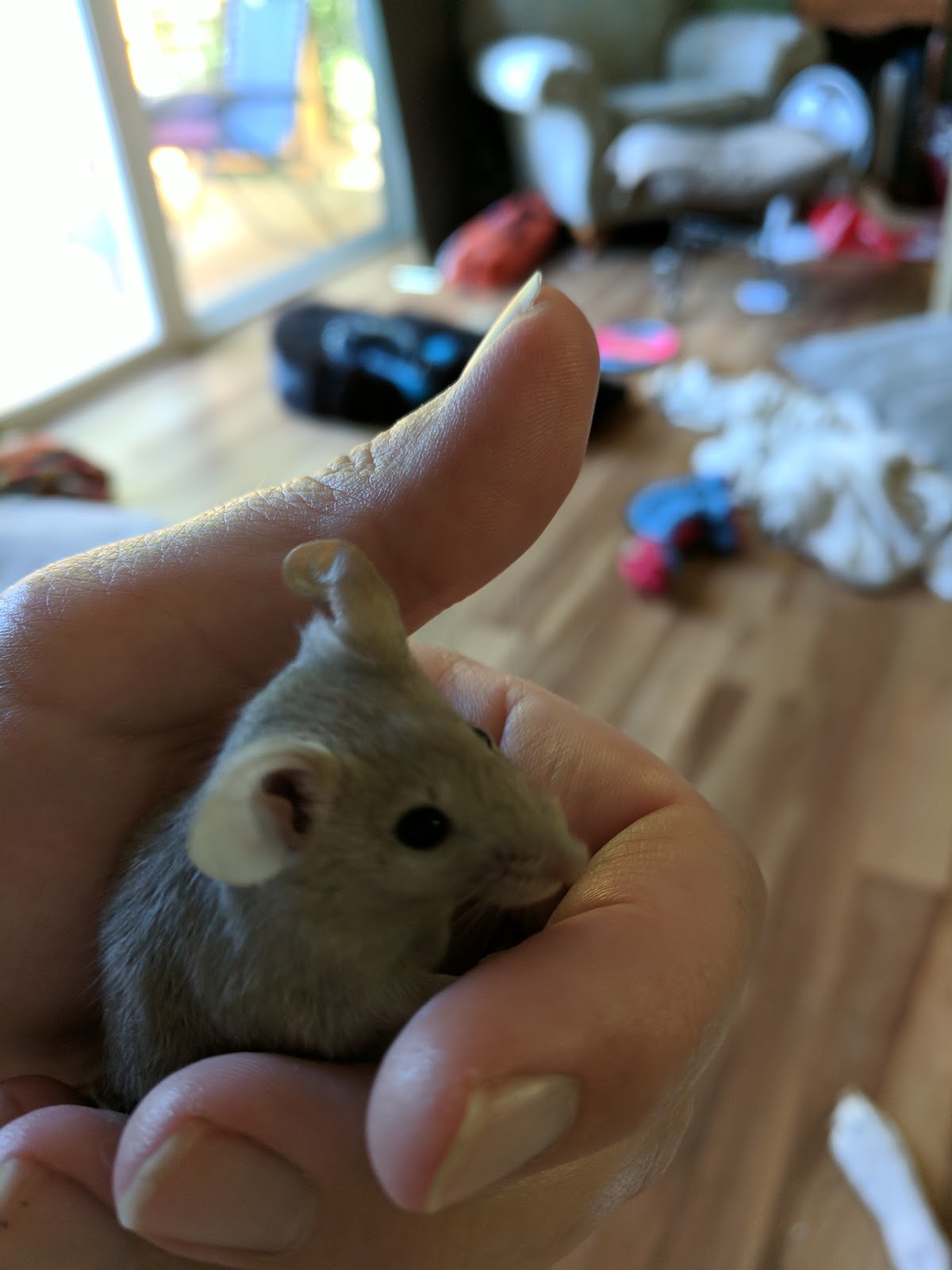
I don't know why the cages I have are deemed suitable for mice. All three of my mice can (and do, on a regular basis) get out of their cage by squeezing between the bars of said cage. I have long known about this propensity of my mice to escape the confines of their (cat-proof) housing - hence the placement of their cage on a rolling cart in the center of the room without anything leaning against it or trailing down off of it so as to "strand" the mice on a sort of island in the bunny room from which they cannot escape so that they do not go roaming about the house on their own. This technique has always worked well for me, so long as I do not leave things on top of the cage, apparently. I made this mistake a few weeks ago, leaving a fabric hammock sitting on top of the cage after the mice chewed off all four of the supports that allow it to hang from the ceiling of their cage. I thought nothing of it at the time but came to regret that decision the following morning when I did my customary head count of the residents of the mouse house. 

Coming up one mouse short of the three that are supposed to be in the house, I counted again. And one more time, just to be sure. Unfortunately, repeated counting did not change the fact that one mouse was most assuredly missing. Josephine had somehow gotten out and off of the rolling cart. As the hammock was also off the the cage and now sitting on the floor I can only surmise that Josephine entered the hammock which then fell off the top of the cage onto the floor below, taking Josephine along for the ride. I had not idea how many hours head start she had on me so I began searching for her all over the bunny room: under furniture, in the closet, and behind chairs without success. This was Monday morning. By Thursday evening I had searched the entire upstairs multiple times over, largely ignoring the downstairs as that is a) difficult for her to get to with two flights of stairs between the upper and lower floors, and b) the domain of the cats, where Mynx and Max regularly hang out. Late Thursday evening, however, we noticed that Max was extremely interested in the closet under the stairs, staring at the crack under the door with unusual intensity. Upon opening the closet we found... wait for it.... nothing. I looked on the floor between my art portfolios where Max had been staring and there was no sign of Josephine: no mouse, no mouse poop, no holes chewed in anything. 

I was about the shut the door when I happened to look at the top of my art portfolio and there she was: Josephine - hungry, thirsty, and probably a bit tired but otherwise alive and well. How she made it from the upstairs to down I have no idea. What I wouldn't have given for a tiny little GoPro mounted on her head to see what exactly she had been up to these last four days. Alas, we will probably never know. I had hopes that Josephine would learn a valuable lesson about the safety and comfort afforded her by a life behind bars, so to speak, but it appears she did not. She was out of the cage again just last night. This time, however, I did not leave anything on top of the cage that could fall off. At least one of us learned our lesson.

Josephine, alive and well, against all odds

Monday, March 4, 2019

More departures on the Unfarm

Ready for your daily dose of depression? I have more departures from the Unfarm to announce, unfortunately.  

First to go was Axel. On February 9, a few weeks ago, we made the ever difficult decision to have Axel put to sleep. Prior to February 9, he had been having some trouble with his eye being a bit teary and goopy so we took him to the vet and got him on eye drops and antibiotics with instructions to return in two weeks for a follow up appointment. At our follow up appointment, however, instead of being improved he was pretty much the same and the vet noticed a small lump on the side of his head. We took x-rays and the results were discouraging to say the least: the upper part of his jaw on the left side of his face was simply not there anymore. It turns out that the bone cancer that we thought we were rid of with the amputation of his front right leg had cropped up in his jaw and eaten away at the bone until there was nothing left. With him at risk of a spontaneous fracture of the remaining portion of jaw and his quality of life taking a turn for the worse we spent one more evening with him at home with all the other animals and took him in to see the vet the next day when Mom could be there as well. Before we left for the vet's office I made him a small batch of carob chip cookies and he had those as his last meal. After that we gathered around him, petting him and telling him that we love him as they put him to sleep. We had him cremated, and placed his ashes into a wooden urn with his picture on the front, reserving a small amount of ashes for a tiny pendant urn that I can wear around my neck to keep him close to me, as we have done with Kita, Maia, and Buddy as well.

Axel was loyal to a fault and would follow me everywhere, barking whenever anyone tried to get near me, even if they were family members. He was always smiling and he just kept on pushing through every obstacle that was thrown at him. He will indeed be a tough act to follow. 

Axel, smiling as ever


Our second departure happened just this afternoon. We lost Penny, our Welsummer hen with the spurs, after a long residence here on the Unfarm (for a chicken, at least.) I was unable to find the photos of her batch of chicks, taken when we first brought her here to the Unfarm, but I was able to find evidence of her being here as far back as 2009, placing her at ten years old at least, which is an admirable feat for a chicken, especially one as low down (at the very bottom, to be exact) on the pecking order as she was. I'm not certain what caused her death - whether it was due to natural causes like age or whether the other chickens beat her up - but I found her today out on the pathway in the back, surrounded by a bunch of her feathers and already passed away. 

Why Penny was so far down on the pecking order is also unknown to me. Of course I can speculate all I like: maybe it was because she had spurs, or because she didn't grow up with the other chickens, or because she broke her toe when she was young and always walked with a limp since then. What I do know is that she was a nice chicken and was spoiled as much as a chicken can be - she got her own coop away from all the others, she got uninterrupted meal times and was free range 100% of the time (whereas the others are closed into the run for half of the day before they are let out), she would hang out in the house with me at times and I even made her a harness to take her for walks out in the front yard. 
Penny in her walking harness

So there you have it; a recounting of the recent departures here on the Unfarm. I can only hope that the next post is more lighthearted. Until then, hug your pets, tell them you love them, and appreciate the time you have with them. 

Monday, January 7, 2019

Three cheese vegetable quiche

I've decided to ring in the new year of blogging with another quiche recipe, although this one is a bit lighter (I feel) than the previous one that I did back in - EEK!- August of 2018. Ahh, how time flies when you are busy procrastinating and taking care of 22 animals of assorted varieties. At any rate, this recipe was tested out on Christmas morning when I was forbidden from doing our usual breakfast of sticky buns, welsh pancakes with orange sauce, and baked eggs because we were planning on doing that the day after Christmas so that my sister and her fiance could partake and my mom said "absolutely not" to doing it two days in a row. She's in weight watchers and is, in general, a killjoy when it comes to the creation and consumption of tasty treats. I did modify this recipe a bit as it originally called for mushrooms and I tend to think of them as being very slug-like once cooked and, therefore, inedible. The general consensus was that it was a very good quiche so I am passing along the recipe to you, gentle reader.

Three cheese vegetable quiche

1 Pillsbury refrigerated pie crust, softened to room temperature
1 tablespoon vegetable oil
1/2 red onion, diced
1 cup milk (I used both whole milk and 2% and both quiches came out fine)
2 large handfuls (approximately 3-4 cups) fresh spinach, diced
1 teaspoon dried minced shallots (or onion)
3 egg whites, lightly beaten
2 eggs, lightly beaten
1/4 teaspoon salt
1/4 teaspoon pepper 
1/2 cup Gouda cheese, shredded
1/2 cup smoked Gouda cheese, shredded
3/4 cup Cheddar cheese, shredded

Heat the oven to 350 degrees F. Roll the pie crust out into a 9-inch glass pie pan and crimp the edges as needed. Prick the crust all over with a fork and bake for 10-12 minutes. Take out and set aside. 

While the pie shell is baking you can work on the filling. In a skillet, heat the vegetable oil and add the red onion and cook over medium high heat until tender, about 4 or 5 minutes. Let cool slightly.

In a large bowl, combine the milk, spinach, minced shallots or onion, egg whites, eggs, salt, and pepper and stir until all the ingredients are well mixed. Stir in the cooled onions, as well as the Gouda and Cheddar cheeses. Pour the whole mixture into the pre-baked pie shell and bake for 35-40 minutes, or until the center is puffed up and light golden brown. Let cool and set up for 10 minutes before serving. Serves 6.

Monday, August 13, 2018

Crustless vegetable quiche

The other day, desperate for a change for dinner from our usual rotation of spaghetti, macaroni and cheese, rice and beans, and stir fry, I found this recipe online and adapted it for what we had on hand and to accommodate my intense hatred of mushrooms. (I tend to think that they have the texture of a slug - not that I have ever eaten a slug but I've seen enough of them to get a rough idea of their probable texture.) I got rid of the mushrooms entirely and replaced broccoli for the asparagus originally called for. I also used a slightly smaller zucchini than was stated in the original recipe because, although I am a vegetarian, I tend not to like vegetables. My general opinion on the categorization of fruits and vegetables is this: if it tastes good, it is a fruit; if it tastes bad it's clearly a vegetable. All in all, although this recipe is full of veggies, it wasn't bad. I would even go so far as to call it quite good. And if you dice the vegetables small enough you might even get a picky eater (such as myself) to eat their greens. 

The prep time is about 20 minutes, depending upon how meticulous you are with your dicing, and the cook time is about an hour. Additionally, even though we ate this for dinner I'm sure it would make a good breakfast or brunch dish as well.

8 egg whites
4 whole eggs
1/2 cup skim milk
1 teaspoon salt
1 teaspoon dried oregano
1/4 teaspoon dried thyme
1/4 teaspoon pepper
16 oz fat free cottage cheese
1 cup shredded monterey jack cheese, divided
1 cup shredded cheddar cheese, divided
1/3 cup flour
1 teaspoon baking powder
1/2 of a yellow onion, diced
1 medium zucchini, diced
2 cups broccoli, diced
1 - 2 tomatoes, diced, seeds removed

Preheat oven to 400 degrees F and spray a 3 quart casserole dish with cooking spray. In a large bowl, whisk together the egg whites and eggs until fluffy. Add in the cottage cheese, 3/4 cup shredded cheddar, 3/4 cup shredded monterey jack, milk, flour, baking powder, 1/2 teaspoon of salt, oregano, thyme, and pepper. In a large skillet over medium high heat, saute the onion, zucchini, and broccoli with the remaining 1/2 teaspoon of salt for about 5 minutes or until tender. Add the cooked vegetables and the diced tomato to the egg mixture and fold everything together. Pour into the casserole dish and top it with the remaining shredded cheese. Place it in the oven on the middle rack. Bake for 15 minutes at 400 degrees then lower the temperature to 350 degrees (leaving the quiche inside the oven) and bake for another 45-55 minutes or until it is set and lightly browned. 

Wednesday, August 1, 2018

Three [escape artist] mice

We have three new mice here on the Unfarm. Recently my two previous mice, Evangeline and Francine, passed away and the mouse cage sat empty with a vacancy sign out front that must have attracted the attention of three new mice who I have named Hermione, Ingrid, and Josephine. (I have been going through the alphabet with mouse names and have already had an Angela, Bernadette, Caroline, Daphne, Evangeline, Francine and Gemima so H, I, and J were up next.)  In addition, as the mice are small and relatively unobtrusive it no longer really phases my parents when I show up with three new ones. Thus Hermione, Ingrid, and Josephine came to live on the Unfarm with very little fuss involved. I suspect that had I also brought home a hamster in addition to the three mice there would have been a bit more uproar so I wisely refrained. Besides, the mice were most likely going to end up as dinner for some snake so I really am in the business of saving lives here. 

Josephine appears to be the oldest of the three as she is the largest. Hermione and Ingrid are likely much younger and upon settling them into their new home I quickly discovered a problem with this: they are so little that they easily fit through the bars of the mouse cage. I checked up on them a few minutes after getting them settled and found only Hermione and Josephine in the cage; Ingrid was running around the outside of the cage. Fortunately I quickly caught her before she could escape into the rest of the house. Unfortunately, all three of my various mouse cages have bars with the same amount of spacing between them so the only way to fix the problem is to set the cage up high on a rolling cart and hope that the height and lack of anything to use to climb down to the ground will deter them from getting lost should they decide to escape. Well, that and to feed them well and hope that they grow fast and soon are unable to squeeze themselves through the bars any longer.

I am, by nature, a bit paranoid and overly anxious so I do check on the mice and do a head count several times a day to make sure that no one has escaped and up until a few days ago the combination of the height of the cage off the ground and the fact that there is really nothing exciting outside the cage (no castle house, no wheel, no food or water bowls) seemed to keep them safely inside the cage. A few days ago, though, I did my morning head count only to discover that one mouse was missing. But she was nowhere to be found on the outside of the cage or the top of the cart so surely I must have miscounted. Nope. There were definitely only two mice in the cage. Becoming frantic I began looking around the room in frustration as there are probably a million places a small mouse could hide and I had no idea where to start. Before I could go into a full blown panic I noticed some mouse droppings on my tabletop easel on the second shelf of the rolling cart. Further investigation revealed a rather frightened looking Hermione crouched on top of the easel. How she got down there I will probably never know. It's not like there were a bunch of tiny mouse sized sheets all tied together and thrown out of the cage dangling down to the second shelf. I retrieved her and placed her back in the safety of the cage (we have cats, after all, who would probably love to catch one of the mice outside the cage.)

Since her misadventure, none of the mice have ventured outside the cage (at least not to my knowledge). Hermione did pop her head outside the cage bars last night but when I peered at her and said, "where do you think you're going?" she pulled her head back in and went about her mousy business. I am hoping that they soon grow too big to get through the bars, much like Josephine, and I can stop worrying so much about them. Until then I plan to continue my head counts and abundant feeding schedule. 

Josephine
Hermione, the escape artist
Ingrid, our original escape artist

Monday, July 16, 2018

Hero worship

The ducks, Fern and Aida - who turned out to both be boys despite my female names for them - adore Gretchen. And who wouldn't? Gretchen struts around the yard like he owns the place. He has a flock of hens to choose from and he always gets the best and tastiest treats simply because he is the largest. No, there are no pesky gentlemanly characteristics to get in the way - he will push anyone aside to get what he wants, whether they are wife, mistress, or daughter. It is no wonder, then, that the boys look up to him and seek to emulate him whenever possible. This emulation includes attempting to mate with the hens who flap and squawk and run away as fast as possible. (But not always fast enough - they have been caught several times even though you would think a chicken could easily outrun a duck... it probably has something to do with the fact that there are two ducks versus the one hen.) It really doesn't matter how many times you tell them that there are no such things as "duckins," they refuse to listen. Or maybe they simply figure that fair is fair - Gretchen tries to mate with Minna, after all. Apparently he believes in the "duckins are possible" theory as well. 

The ducks are let out first in the morning and Fern and Aida will often forego a large breakfast in favor of running up to the dog run fence to watch as Gretchen then eats his breakfast. The rest of the day the boys spend following Gretchen around the yard as best as possible. The boys are unable to fly up and over the dog run fence so if the chickens happen to be in the dog run (where their coop is located) the ducks are out of luck and have to settle for walking along the fence line staring at Gretchen all the while. If Gretchen does happen to leave the dog run and head out into the yard, the boys can usually be found within several feet of him. They dare not follow too closely as Gretchen tends to turn on them and chase them off but this has done nothing to dampen their hero worship of him. It seems that in their eyes, Gretchen can do no wrong, which is a refreshing change from listening to my dad and my brother complain about "Hooligan" (the name Dad has taken to calling Gretchen) and his dislike of men and certain neighbors which he expresses by attacking them. But as he would likely be butchered if we were to send him anywhere else, re-homing him would probably be a death warrant so for now at least "Hooligan" stays and the ducks will continue to have someone to look up to.

The boys, hanging around outside the dog run fence while Gretchen ignores them from within. Aida is on the left and Fern is the one with more white on his head, on the right.

Gretchen, in the yard, with the boys remaining at a respectful distance.